

How To Draw How To Draw Hair
- Dwelling house
- Portrait Drawing
- How to Draw Hair
How to Draw Hair (Realistically!)
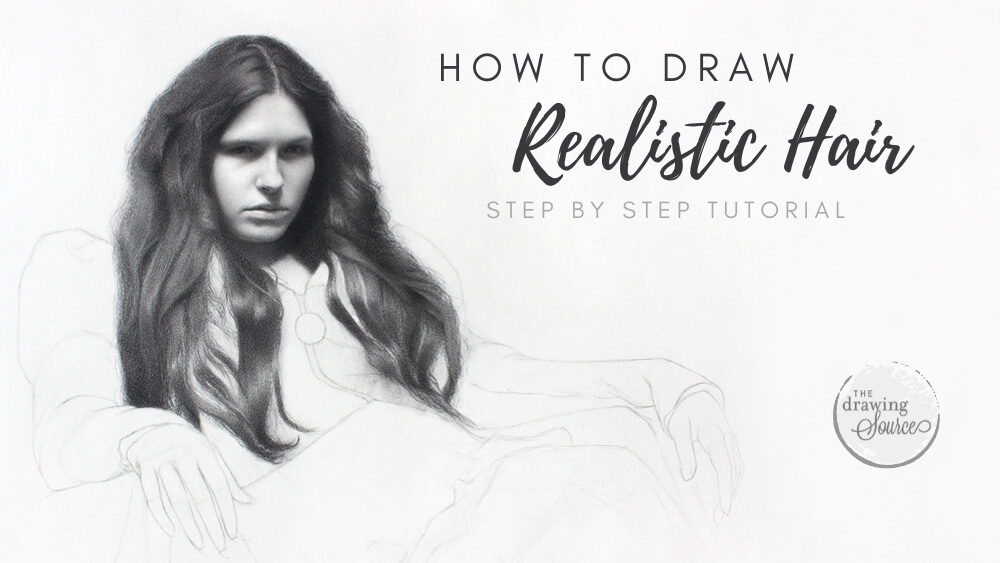
Learning how to describe hair can experience like an always-changing, daunting job at starting time. Hair varies and then much from hairstyle to hairstyle that it requires us to be flexible in our approach. In this step by pace hair drawing tutorial I'll nowadays concepts to assistance you problem solve your fashion through all of your hair cartoon sagas.
To get the most out of this lesson, take my free Mini-Course on the essential concepts of realistic cartoon. These video lessons volition give yous a framework, or 'society of operations', for approaching drawings of any subject field thing, including hair.
Finally, don't miss the downloadable pilus cartoon infographic at the lesser of the page, also every bit this braid cartoon tutorial!
In this lesson yous will learn:
- How to simplify such a complicated bailiwick as hair
- How to draw pilus that looks similar your model's without obsessing over every detail
- Tips for designing hair that leads the viewer'south eye around the drawing
- How to depict realistic, dimensional locks
And, of course, I will show you lot the step by step process of creating the drawing above!
F R East E D O W N L O A D
At the end of this article, download a free How to Describe Hair Infographic!
How to Draw Hair
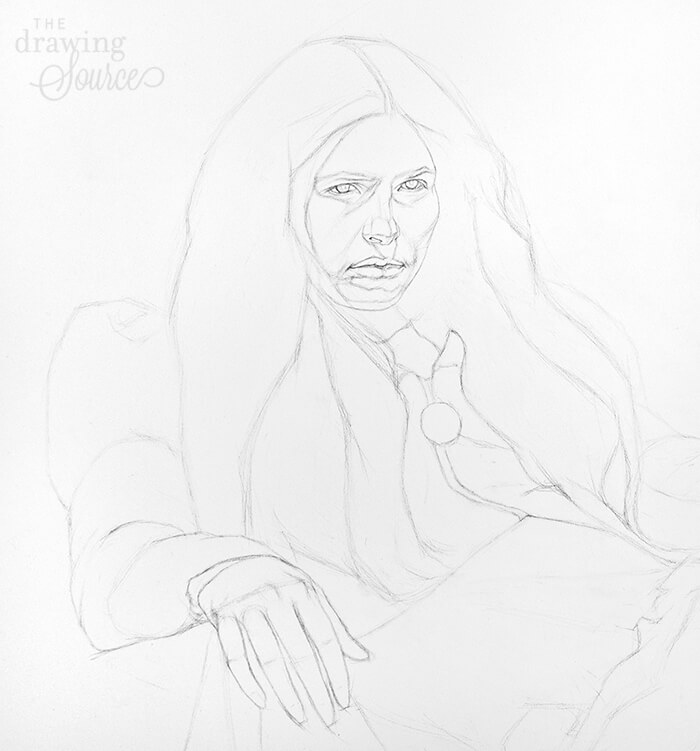
Because the focus of this page is on how to draw hair, I'll begin with the face already blocked in (drawn or synthetic using line). (For a step past step tutorial on how to draw the face, please visit this Portrait Cartoon Tutorial. )
Simplifying the Complex and Creating Flow
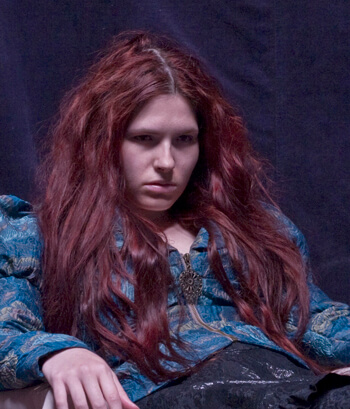
This drawing scenario is quite challenging. How do y'all go about drawing the hair when it is as busy and detailed as this?
Begin past finding the major sections of the hair past looking for:
-Major value changes and high contrast areas
-Changes in direction of the autumn of the hair
-Major shapes in the hair (more on this later)
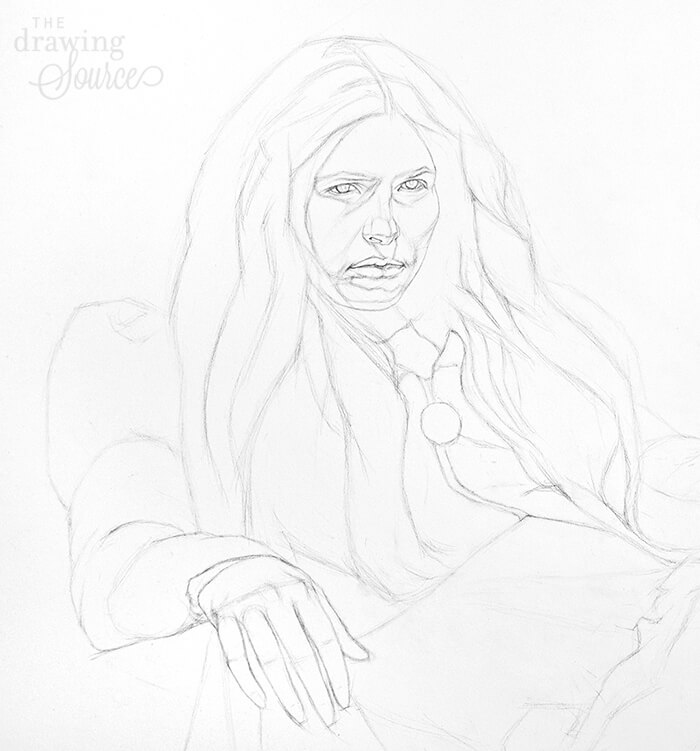
You can meet what I considered to exist the major sections of the hair below:
How to Describe Pilus: Finding Gestures
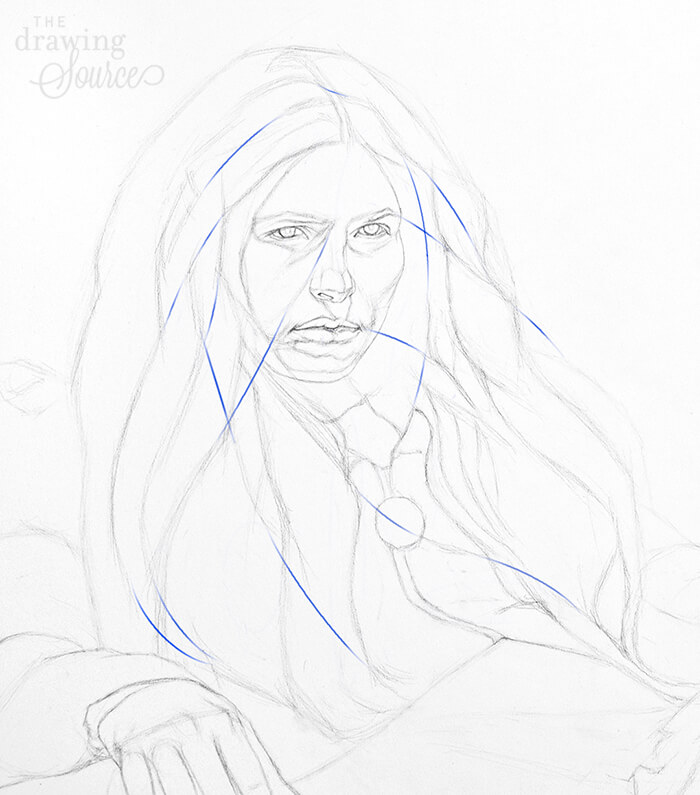
Near often I suggest to draw all block ins using straight lines. However, in this case I am drawing the pilus about exclusively with curved lines because I want to achieve a feeling of "flowing" hair right from the start of the drawing.
When learning how to draw pilus, 1 mode to reinforce this flow and interconnectedness while improving the accuracy of your cartoon is to wait for gestures. Y'all tin think of gestures as invisible, curved lines that flow from one chemical element of a moving picture to another, creating a kind of underlying structure that connects all the elements in an epitome.
In the to a higher place image, you can see that even though my drawn lines are non literally continued, the blue line suggests how the eye might travel from i to another. In this mode, you tin can make certain that every line visually leads to another line in the drawing.
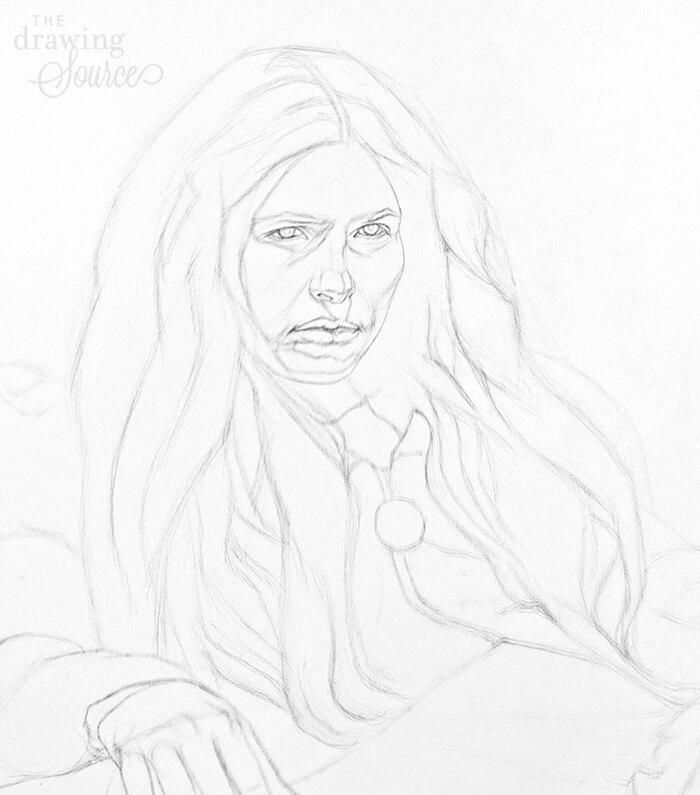
This is where I will stop working on my block-in with line. It doesn't make much sense to go into more detail at this bespeak because I will lose some of my drawing when I start drawing in values. However, just because I am moving to value drawing does not hateful that the block-in stage is over.
Setting Your Mindset and Goals for Your Drawing
It is e'er easier to get somewhere when you know where you lot desire to go. The aforementioned applies to cartoon. When you have an idea of what yous desire to draw or communicate (whether it is a particular look, mood, atmosphere, etc.), that goal tin can guide all of your decisions. That manner, if you are always unsure of what to do next, you lot tin check in with your intention and it will help you figure out how to continue.
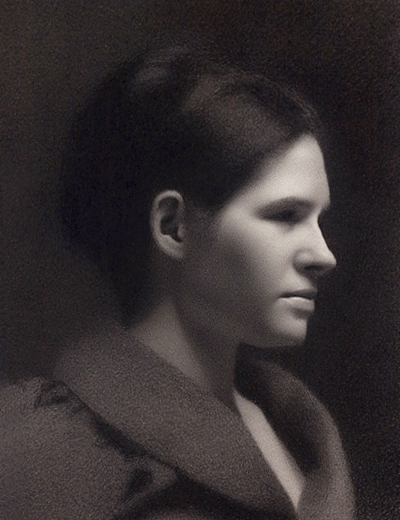
I mention this because particularly in this kind of drawing scenario, it is piece of cake to get caught upwardly in details but considering they are in that location.
Instead of becoming a slave to what is in front of you, let the goals yous set for your cartoon dictate the amount of item yous draw, and when your cartoon is "finished".
For case: My trend is actually to simplify hair, as I did in the drawing to the left for my previous portrait drawing tutorial.
(At the time of writing this) I have never drawn a portrait in which the hair is every bit important as it is in this electric current scenario. And so, my goals for this drawing will be to:
- Experiment with cartoon more item in the hair than I ordinarily would
- Figure out how to depict pilus in such a way that the viewer's centre moves through it, not getting "caught" in any one area
To reach both of these goals, cartoon every hair or ringlet that I meet does non take to be a priority. Instead, part of my claiming volition be to figure out how to design what I see. To decide which details are important to include and which I can simplify or leave out of my drawing. I desire my pencil marks to be considered, conscious decisions.
How to Draw Pilus...
That Actually Looks Like Your Model's!
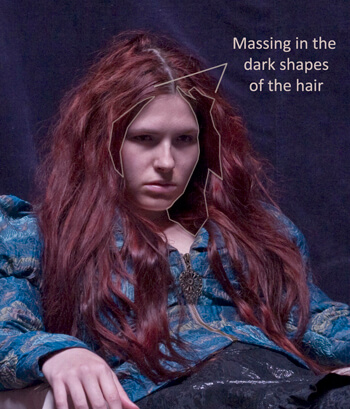
If you squint at this image (one of the almost effective methods of simplifying what is in front of y'all) you will notice that much of the hair masses together, showing us how shut in value it is.
The gradations in the hair are very subtle, especially when you compare them to the contrast in the confront.
To simplify, I volition start with the most obvious values: the lightest and darkest, and work my way to the most subtle.
The lightest value tin can exist left as the white of the paper, and the darkest value is just to the right of the face (our right, the model'south left). To accept this ane step farther, when I squint at the model I notice that the darkest value masses together with the slightly lighter area of the hair correct next to it, creating a distinct nighttime shape.
Drawing the shapes specific to your subject creates a likeness.
This is true no affair what y'all draw,
whether information technology is a still life, portrait or figure.
Throughout this drawing I will exist looking for shapes, get-go with general ones and moving towards more and more specific ones. I discuss how to use shape to create a likeness of your subject and nowadays a shape practice in Lesson 2 of my gratuitous Mini-Class.
It's worth repeating: The specificity of shapes is what creates a likeness.
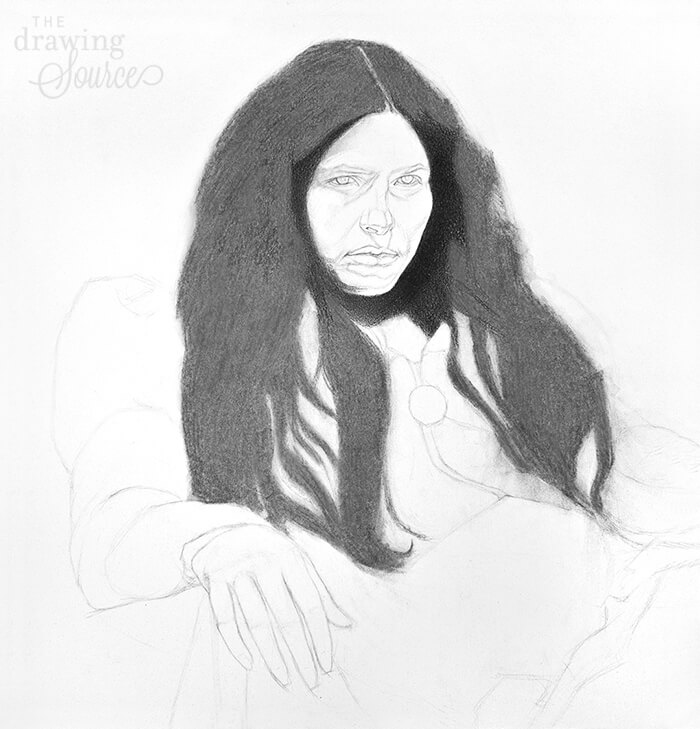
In the above prototype, I take drawn iii steps:
- I massed in the two dark shapes
- I used vine charcoal and a soft bristle brush to describe a flat graphic shape for the rest of the hair
- I and then drew the gradation under the mentum, connecting the shadows on both sides of the face up
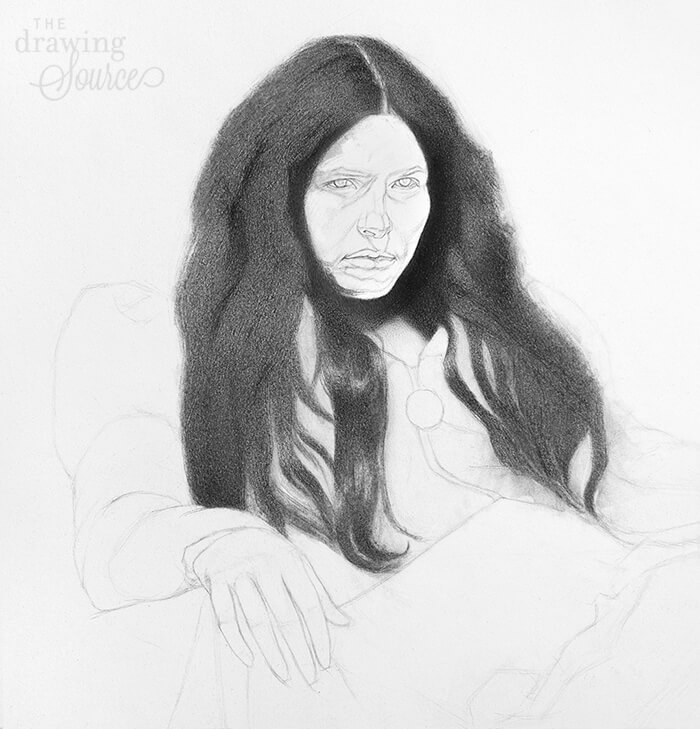
I am continuing to notice and depict the dark shapes in the hair. This preliminary addition of tone tin can be considered the 'block-in' of the value stage. Everything I draw is nevertheless tentative, field of study to modify, and there is no sensitive rendering nonetheless.
Looking at the bottom department of hair under the chin: All I have done here is find the dark shape, notice the approximate low-cal shape with my eraser, and slightly gradate in between the two. I oasis't evened out the values, yet it is already starting to wait similar dimensional hair, especially when compared to the surrounding flat shapes.
This is a strategy I will utilize throughout the drawing: finding the dark shapes, then the low-cal shapes, and creating a gradation betwixt the two to create the half-tones. However, before I continue I should constitute the rest of the values in my moving picture by drawing the face up.
Rendering the Confront
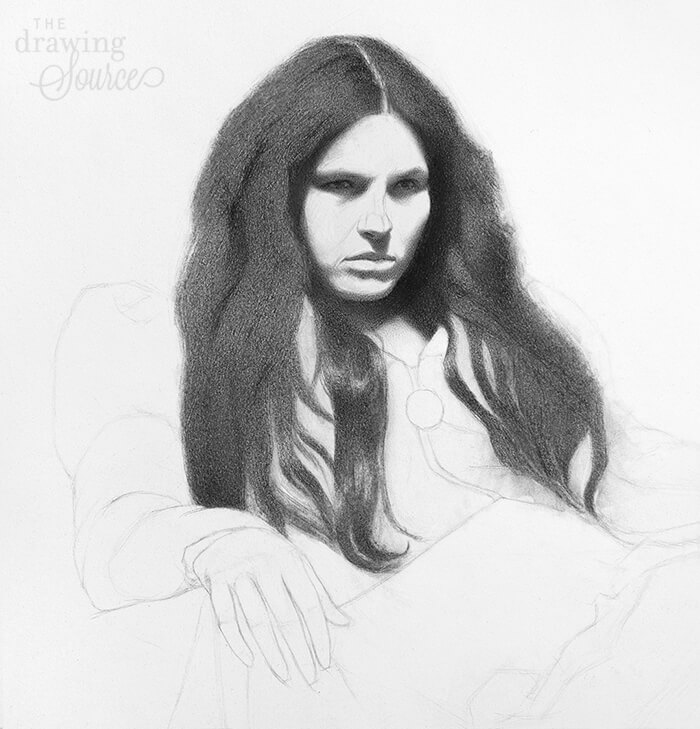
Since this tutorial focuses on how to draw pilus, I will go through rendering the face up in only a few steps. For an in-depth footstep past step tutorial on shading the face, please click hither.
I brainstorm rendering by massing in the shadows (remember: specific shapes = likeness!) From here I start creating gradations from the shadows into the one-half-tones.
If you refer to the reference photograph, y'all will notice that the left side of the face up (the model's left, our correct), is generally darker than the right side. This suggests that some other manner to begin rendering the face could exist to mass in a light value across the whole left side of the face earlier continuing to shade.
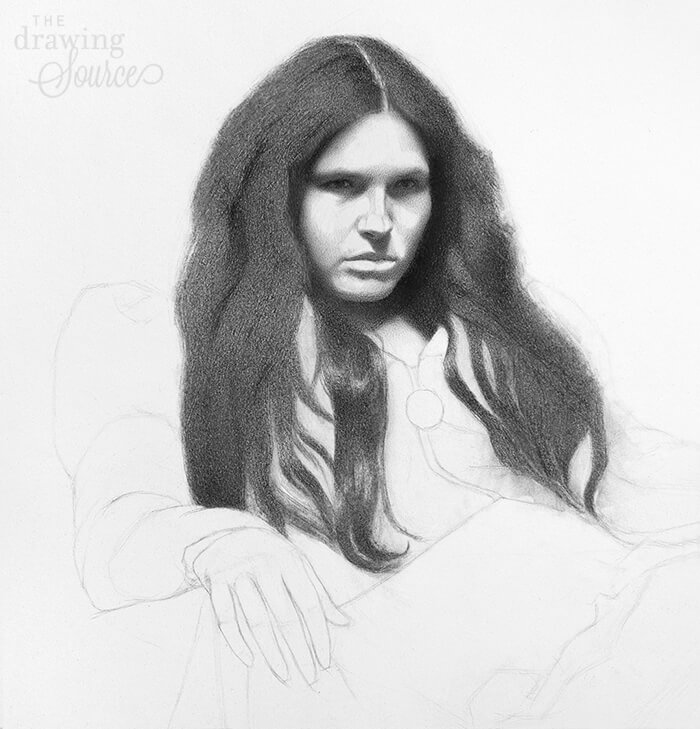
As you can see, I tend to move around the face as I render. For example, I might commencement with the hairline (which is ofttimes a nice soft edge to begin shading from), motility to the cheek, then the chin and and then on, without shading any 1 area to completion.
I do this and so that I accept more and more values to compare, minimizing my risk of cartoon inaccurate value relationships (not a inkling what those are? Read about them on the Value Drawing page or watch Lesson 5 of my free Mini-Class).
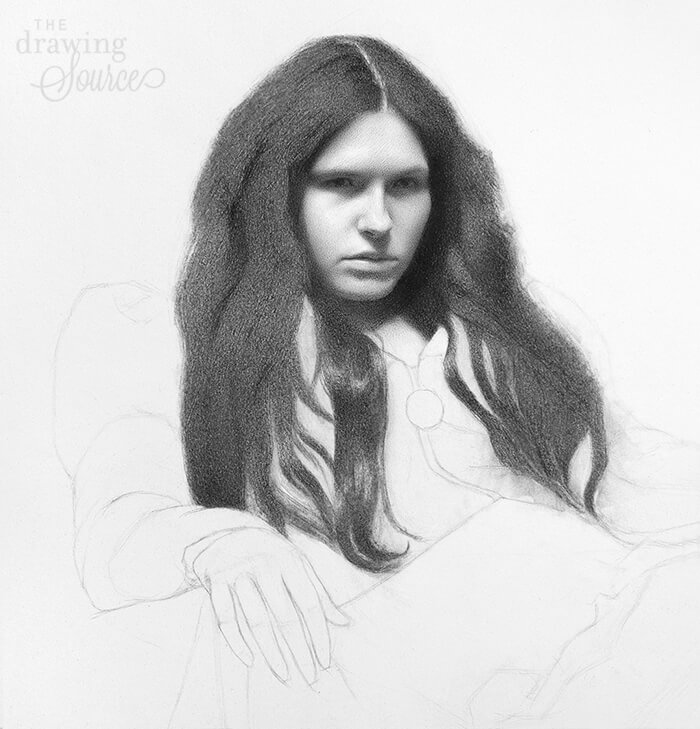
Now that I have drawn the face, I have all the values to compare to that I could always need. This is a good fourth dimension to step back from the drawing, evaluate, and program my adjacent steps.
How to Depict Hair: Thinking of Hair every bit Form
To exist assuredly realistic in a drawing: 1) The hair must describe the course of the caput.
Let'southward face information technology, the class of the head is basically an upside down egg. No affair what the model'due south hairstyle, there is unremarkably an area of hair that lies flat on the caput and reveals the grade. It is this surface area that is particularly important to pay attention to, otherwise the pilus won't look believable, or the skull may look strangely shaped.
2) The pilus must follow the same lighting pattern as the confront.
For case, the calorie-free must look like information technology'due south coming from the aforementioned direction and have the same intensity or brightness throughout the drawing.
3) The pilus cartoon must assuredly represent the elements of lite and shadow on class (such every bit the highlight, half-tone and shadow).
Non only does hair draw the course of the head, hair tin can be thought of as grade itself. But as there are many ways to conceptualize the caput when drawing a portrait, there are but as many ways to conceptualize pilus as form. For case:
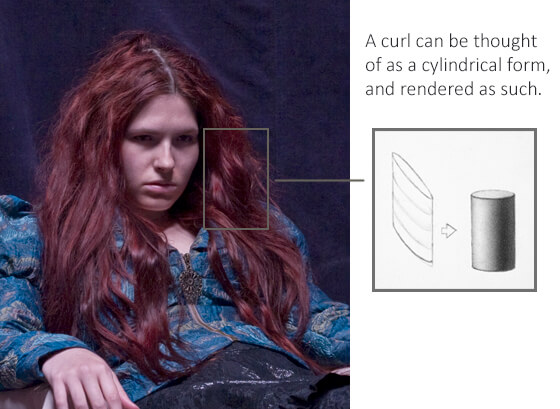 How to describe pilus: by viewing curls every bit cylinders
Hair can be thought of as diverse forms depending on the hairstyle. For example, some curls can be thought of equally cylinders, and can exist rendered in much the aforementioned way. Detect that both the roll and the cylinder have a highlight, halftone and shadow area. The core shadow on the curl is somewhat obscured by its texture.
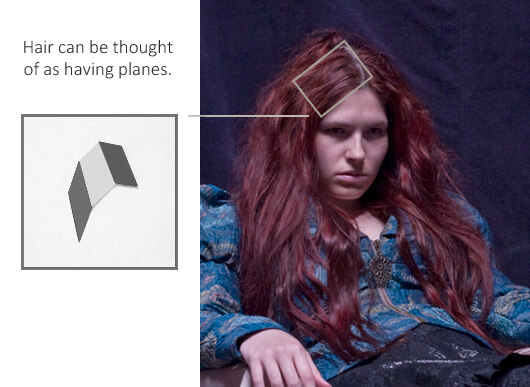 How to draw hair: by viewing information technology as having planes
It can exist helpful to visualize pilus as having planes, just every bit forms do. In this example, the highlight shape of the hair is the airplane receiving the most directly light, and as the planes turn abroad from light they become incrementally darker.
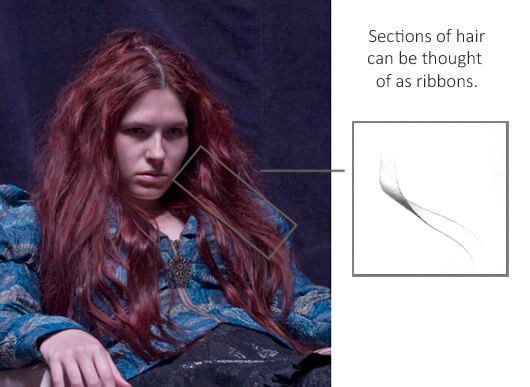 How to depict hair: by viewing it every bit ribbons
Finally, y'all can think of sections of pilus as ribbons that have a thickness and texture.
To keep yourself picturing pilus as form while you draw, ask yourself:
- What class does this section of hair resemble?
- Where are the highlights, halftone and shadow areas on the form?
- How would you return the grade that this department of pilus resembles? The manner you would draw that form is the style yous should draw that section of hair. In one case the structure of that section is established, then you can add the illusion of texture by drawing some of the private strands.
The form of the hair should exist your acme priority. Texture comes concluding.
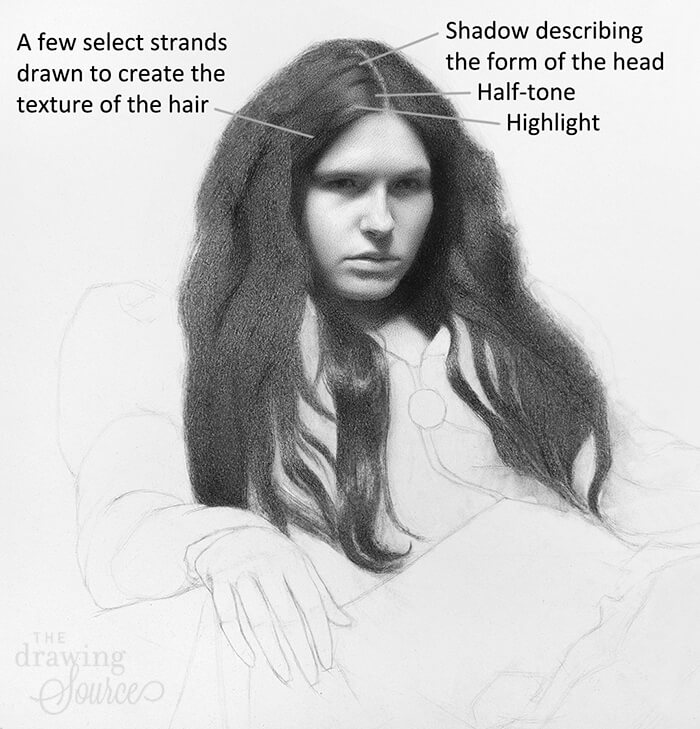
I have rendered the hair at the superlative of the head, using both the grade and shape approaches discussed. (Notice that this is where the pilus lies flattest on the head, revealing its form.)
Starting time, I drew the carefully observed highlight shape. Then I drew the shadow shapes, because finding the half-tone (or heart value) is easiest when you first have the two extremes: light and dark.
Finally, when I was happy with the overall form and 3D quality of the fatigued hair, I drew merely a few individual strands to create the illusion of texture. Notice how few strands I had to describe on top of the form to attain the illusion of hair.
Note: Notice that the left side of the model's face (on our right) is slightly darker than the correct side. To create the illusion that the hair and confront are being lit by the same calorie-free source, the left side of the hair also needs to be darker than the right side.
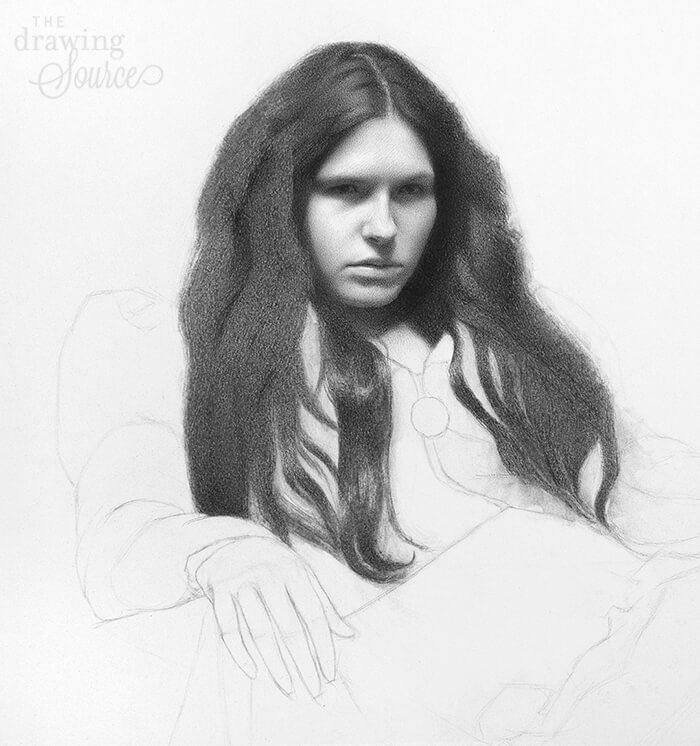
As I go on cartoon I await for "ribbons" of pilus to indicate , commonly with a highlight and halftone.
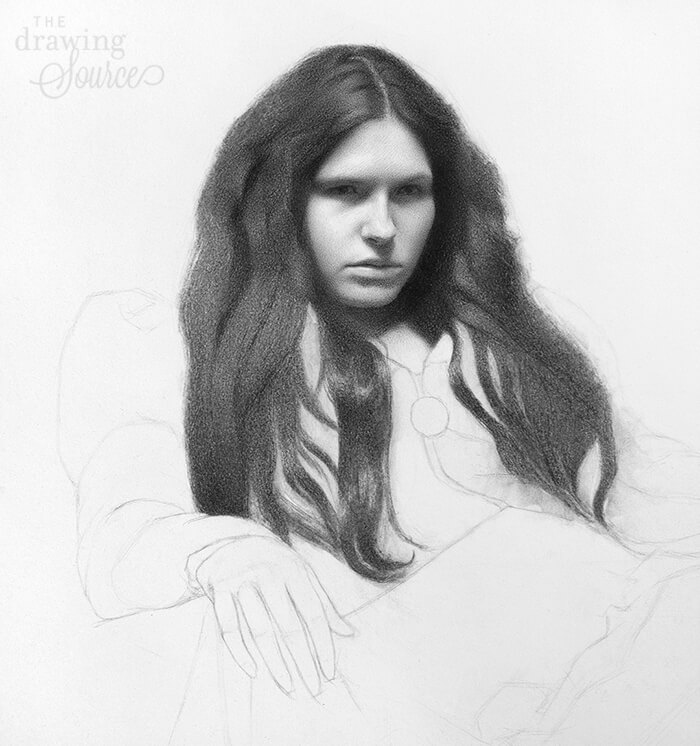
I am working from general to specific as I draw the hair. For example, most halfway down the hair on the left, light illuminates all three sections of hair. In the step before this one, I noticed this and made them all the aforementioned, lighter value.
In this stride I looked more specifically at each section and defined the shapes with highlights and subtle half-tones. Notice that while they all expect ribbon-like, they are not repetitive and each has a unique shape and curve of its own.
I am using my kneaded eraser just as much as I use my pencil throughout this drawing. Information technology's a fantastic tool for drawing hair because it can be used to choice out specific details, or to lighten larger areas of value. Watch this video tutorial on my 3 favorite kneaded eraser techniques for realistic cartoon here.
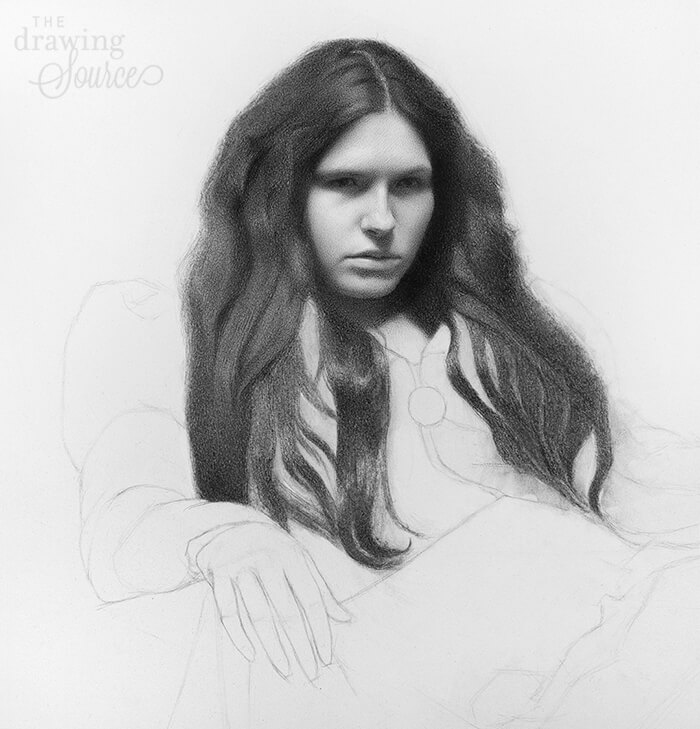
I am keeping the darkest values and highest dissimilarity effectually the confront. I am purposefully keeping the lower one-half of the hair lighter because high contrast and dark areas attract the eye, and I desire to make certain that the face up remains the focal point, fifty-fifty with all of this distracting hair.
How to Draw Hair: The Finished Hair Drawing
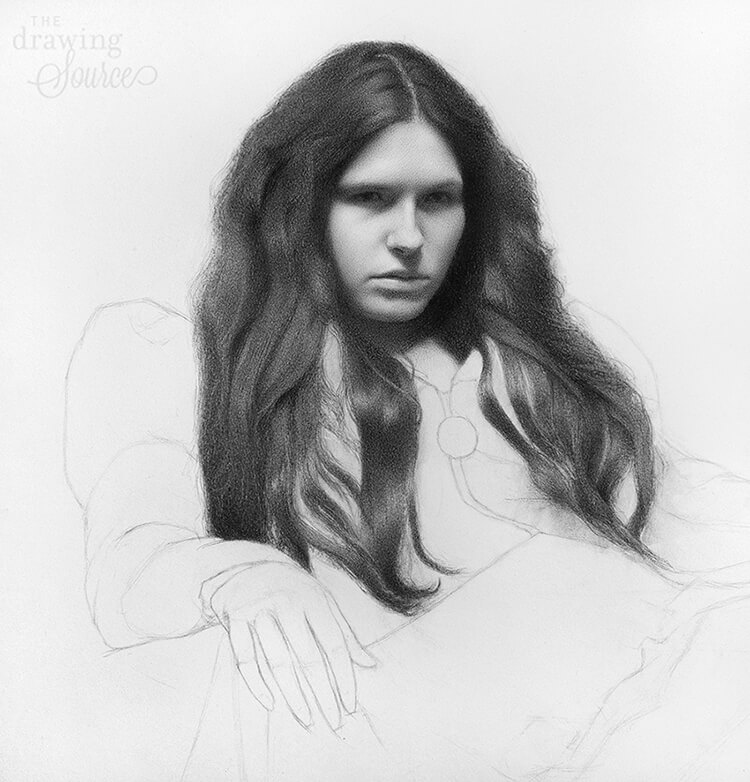
Here is the completed drawing!
Since the previous pace, I have:
- Added a few specific highlights
- Evened out the values in the pilus at the lesser correct of the drawing
- Added individual strands of hair to reinforce the illusion of texture
- Worked on the profile of the pilus
How to Depict Hair: Refining the Contour
It's of import to interruption up the outside edge of the pilus so that it'southward not 1 continuous line, or the drawing will look like a sticker on the page. Create variations in edge quality (softer and sharper edges) for the nigh conceivable effect. (Watch Lesson vi of my complimentary Mini-Class to learn four techniques for drawing edges finer!)
You tin can also draw slight gradations effectually a few areas of the outline, as I take washed, then that the pilus doesn't terminate also abruptly. Finally, the contour is a great place to have fun adding flyaway hairs!
I hope you've enjoyed this tutorial on how to draw hair! Don't miss the downloadable pilus drawing tutorial infographic below, likewise as this tutorial on how to draw a realistic braid.
Happy Drawing,
Downloadable Resources


Enjoyed this page? Please share it!
Share buttons and pinnable image below:
If you enjoyed this tutorial on how to draw hair, you may too be interested in...
Related Pages
How to Draw a Braid (Pace past Step)
How to Start a Portrait Drawing (Footstep by Step)
How to Shade a Portrait Cartoon (Step past Step)
5 Proportions of the Face to Know
3 Ways to Employ a Kneaded Eraser for Realistic Drawing
Return to Drawing Tutorials from How to Depict Hair

Source: https://www.thedrawingsource.com/how-to-draw-hair.html
Posted by: mauriellogers1988.blogspot.com
0 Response to "How To Draw How To Draw Hair"
Post a Comment